You are not bad at time management. Decades of research point somewhere else entirely: procrastination is short-term mood repair. You are not avoiding the task — you are avoiding a feeling the task carries.
Psychologists Fuschia Sirois and Timothy Pychyl reframed the field with this finding. The report due Friday carries fear of judgment. The unopened bank app carries shame. The application carries fear of rejection. Scrolling instead does not manage your time badly; it manages your mood successfully — for about ten minutes, at the cost of the evening, followed by guilt, which makes the task feel worse tomorrow. That is the whole spiral, and calling it laziness has never once broken it.
How to actually stop procrastinating
1. Name the feeling, out loud
Before the avoided task, finish this sentence in five words or fewer: “I am avoiding the feeling of ___.” Neuroimaging research on affect labeling shows that naming an emotion measurably reduces the brain’s alarm response. Named, the fear shrinks to a manageable size. Unnamed, it prices the entire task.
2. Shrink the task below the alarm threshold
Cut it to two minutes: open the file and read the last line. Put one dish in the sink. Draft one sentence of the email. Your brain’s ancient energy auditor vetoes big plans and waves small ones through — and the two-minute door, in practice, mostly opens into longer rooms. On the days it does not, two minutes still banked, and the spiral stayed broken.
3. Give it a trigger, not a time
“I’ll do it at 7” asks memory to watch a clock. Write the sentence instead: after X (something that already happens daily), I will do the two-minute version. Backed by a meta-analysis of 94 studies.
4. Bank the evidence
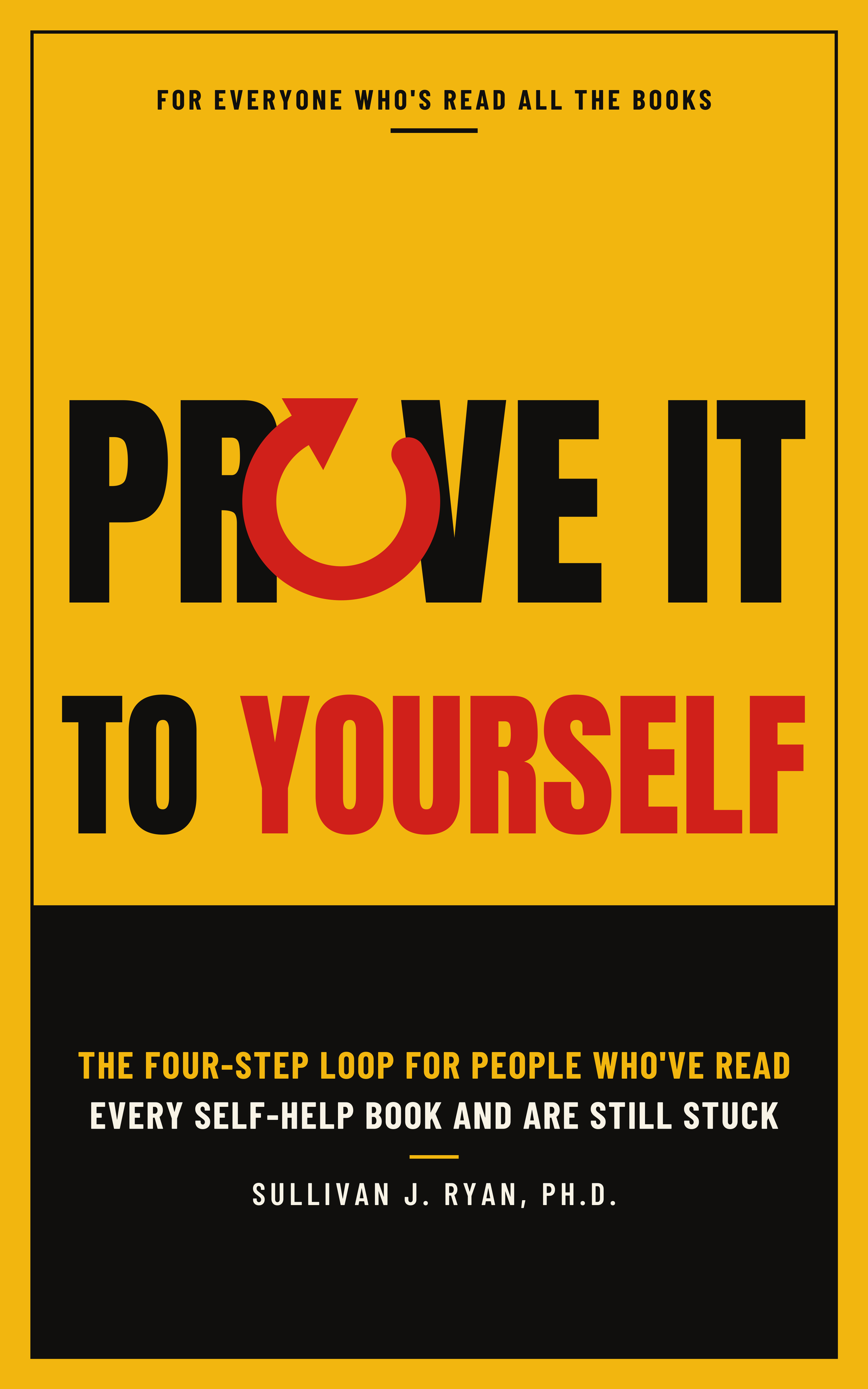
One dated line in a notebook: “Tuesday. Opened the file.” Procrastination feeds on the story that you never follow through; a growing log is the only argument that story cannot survive. This is the Proof Loop, and the free 30-day journal gives you the ruled pages.
- Procrastination is mood repair, not laziness. Treat the feeling, not the calendar.
- Name the feeling in five words. Shrink the task to two minutes. Trigger it, then bank it.
- The spiral breaks at the start line, never at the finish line.
Sources: Sirois & Pychyl on procrastination as emotion regulation · M. Lieberman et al. on affect labeling · Gollwitzer & Sheeran, 94-study meta-analysis.