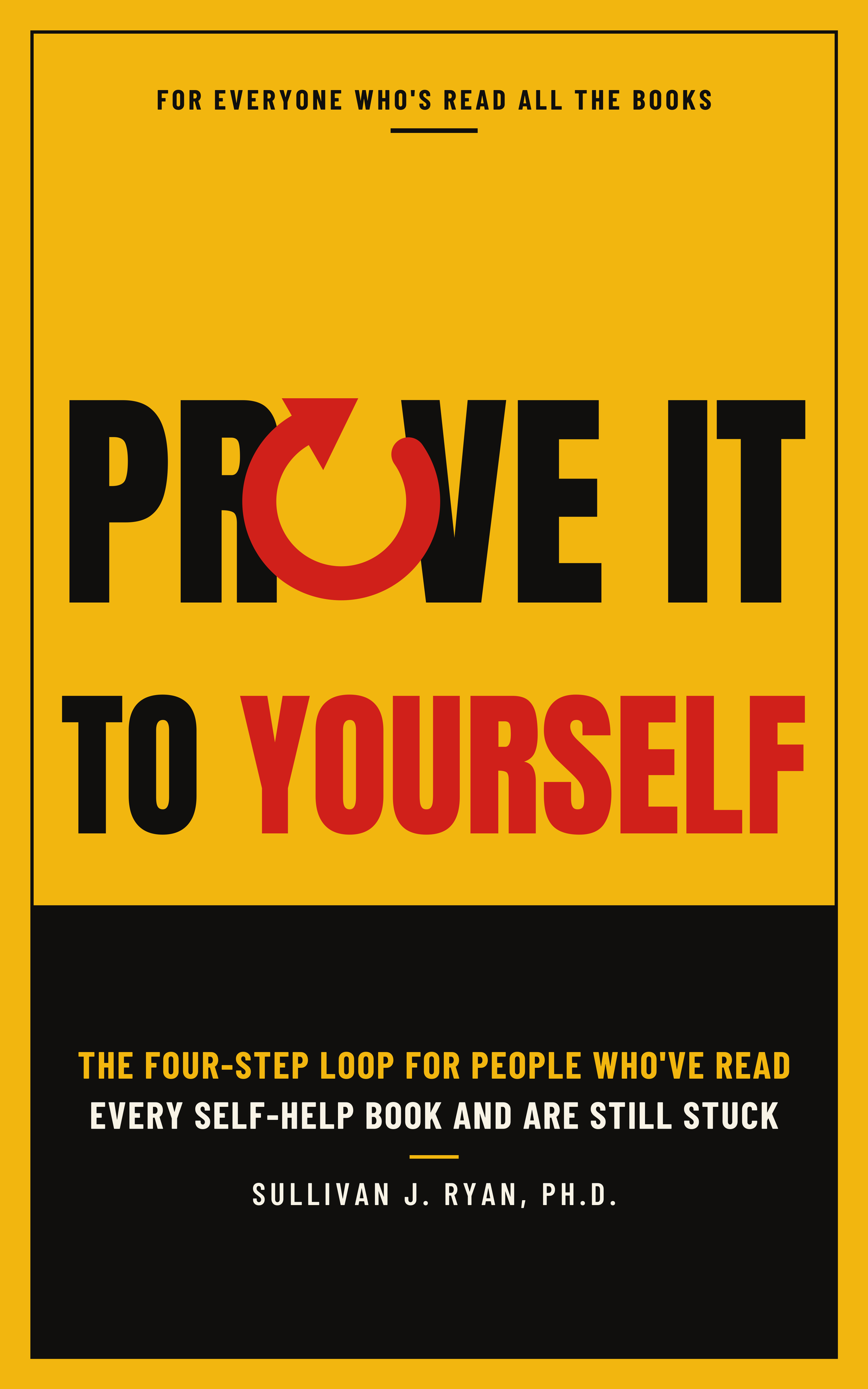
You've read the advice. You've watched the videos. You know what you're supposed to do. So why are you still stuck?
Here's the answer this method is built on: you are still here because the standard model of change is broken, not because you are. The standard model says get motivated, then act, then become. It fails at step one, daily, because feelings don't arrive on command — and then it blames the user.
The Proof Loop runs the other direction. Act first, in tiny ways. Collect the evidence. Let belief assemble itself from the record. Psychology has been quietly proving this reversed model for decades. Almost nobody sells it to you, because there's nothing to sell: it costs one notebook.
The two findings that flip the arrow
First: the strongest known builder of self-belief is not encouragement, visualization, or affirmations. Albert Bandura, one of the most cited psychologists in history, spent a career measuring what grows a person's confidence that they can do things. His answer, replicated for decades: mastery experiences — small, real, completed wins. Nothing else comes close.
Second: you learn who you are by watching what you do. Psychologist Daryl Bem called this self-perception, and the core has held since the 1960s. Your inner observer doesn't count intentions, plans, or highlighted passages. It counts behavior. No behavior, empty ledger — no matter how inspired you felt.
Put them together and the arrow of change reverses. The shelf says belief comes first and action follows. The evidence says action comes first, in tiny observable pieces, and belief assembles itself from the record. So we build a machine for generating small evidence.
Step 1 — Shrink
Take the goal and cut it down until starting costs almost nothing. Two minutes or less. One page becomes one sentence. A workout becomes one rep, or just putting on shoes.
This is not settling — it's engineering. Your brain runs an ancient energy-accounting system (evolutionary biologists like Daniel Lieberman have documented how deeply conservation is wired in). Big plans get vetoed by that auditor daily; two-minute acts slip under the door. You're designing an action that survives your worst day, because a loop that only runs on good days isn't a loop. It's a mood.
Step 2 — Act, on a fixed trigger
Write one sentence: After X, I will do Y. Choose an X that already happens every day, and bolt your tiny act to it. After I pour the morning coffee, I write one sentence. After I park the car, I do one rep.
This format — the implementation intention, introduced by Peter Gollwitzer — is the single best-tested tool in behavioral science. Gollwitzer and Sheeran's meta-analysis across 94 studies found it reliably and meaningfully closes the intention-behavior gap. Notice what the sentence doesn't mention: feelings. The trigger fires whether you're inspired or gray. Motivation is not consulted. That's precisely why the engine survives.
Step 3 — Bank
Immediately after the act, write one line where you'll see it. A cheap notebook that lives at the trigger site. Date, act, done. "Tuesday. Wrote one sentence."
That line is the spark plug of the whole machine. The written line is what your inner observer counts — Bandura's mastery experience, made visible. On hard days you won't believe your own pep talk, and you shouldn't. You'll believe the log, because the log is just true. There's remarkable science here too: Maier and Seligman's 2016 reappraisal of fifty years of learned-helplessness research found that passivity is the default and control is the thing that is learned — through exactly this kind of repeated experience of action producing effect. And it generalizes.
Step 4 — Repeat
Same trigger, same tiny act, tomorrow. Expect it to feel manual before it feels automatic: in Phillippa Lally's real-world study of habit formation, automaticity took a median of about ten weeks, with wide personal variation. And write this inside your notebook's front cover: in that same study, missing a single day made no measurable difference. The engine is forgiving by design. The only streak rule worth keeping: never miss twice.
- Pick one goal. Only one. Cut it to a two-minute act, smaller than feels respectable.
- Write the sentence: "After [something I already do daily], I will [tiny act]."
- Put a notebook and pen physically at the trigger site, tonight.
- Tomorrow, run it once and write line one. The free 30-Day Proof Journal gives you the ruled pages.
Two honest warnings
The loop will feel too small. Your ambition will complain that one sentence is beneath it. The size is the technology. Every failed massive plan in your past died of expense; this one is priced to run forever, and a tiny act performed two hundred times beats a heroic act performed twice by a distance that will embarrass you.
The loop is quiet. No rush, no montage. Around week three, the quiet gets mistaken for failure. It is not failure. It is what working actually sounds like.
Sources: Bandura, Self-Efficacy: The Exercise of Control (1997) · Bem, self-perception theory · Gollwitzer & Sheeran, meta-analysis of 94 implementation-intention studies (2006) · Maier & Seligman, "Learned Helplessness at Fifty," Psychological Review (2016) · Lally et al., European Journal of Social Psychology (2010) · Lieberman, Exercised (2021). Where research is contested, this site says so.